

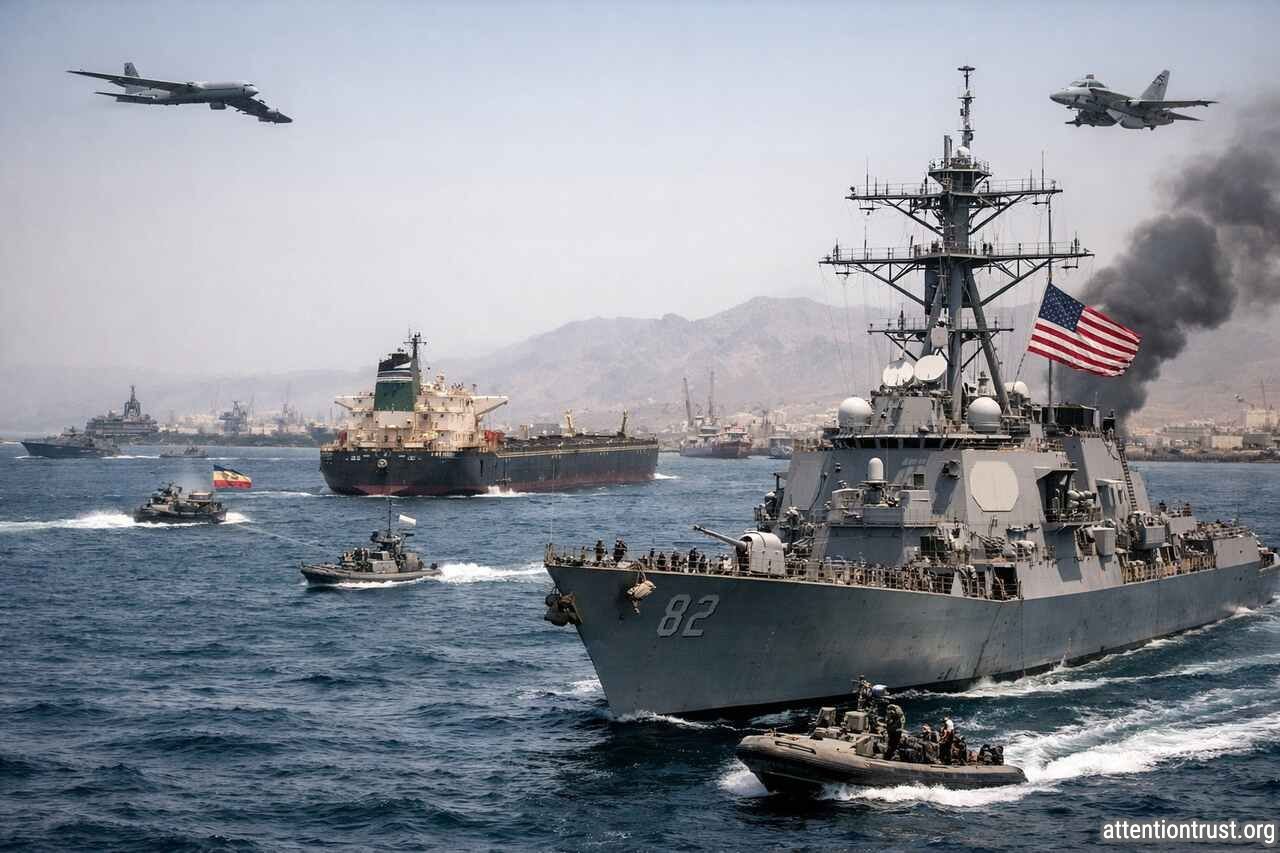
BEIRUT—Iran said Friday that the Strait of Hormuz is now fully open to commercial ships. However, U.S. President Donald Trump said that the blockade on Iranian ports and ships “will remain in full force” until Tehran makes a deal with the U.S. that includes a deal on its nuclear program.
A 10-day ceasefire between Israel and the Iran-backed militant group Hezbollah in Lebanon seemed to hold, according to a post on X by Iranian Foreign Minister Abbas Araghchi. This meant that the important waterway through which 20% of the world’s oil is shipped was now fully open to business vessels.
At first, Trump was happy. He wrote on social media that Iran had said the strait was “fully open and ready for full passage.” But a few minutes later, he wrote another post saying that the U.S. forces would keep the blockade in place “UNTIL SUCH TIME AS OUR TRANSACTION WITH IRAN IS 100% COMPLETE.”
The president also said that Iran is trying to clear the strait of mines with help from the United States.
This week, Trump put up the barrier after Iran limited traffic through the strait because of fighting in Lebanon. Iran said this was a breach of the ceasefire that the US, Israel, and Iran had agreed to, which was mediated by Pakistan.
Trump said at the time that the blockade would have a “all or none” approach to try to get Iran to open the strait again.
Even though Iran made an announcement, the president decided to keep the ban in place. This was likely done to keep pressure on Tehran since the fate of the two-week ceasefire that was reached last week is still unknown. Since the U.S. and Iran had different ideas about Iran’s nuclear program and other issues, their direct talks last weekend did not lead to a resolution.
A truce in Lebanon could help bring peace between the US and Iran.
The price of oil dropped because people thought a deal would be reached. In case the strait doesn’t open again, the head of the International Energy Agency said that energy shocks might get worse. Soon after the war started, Iran blocked the important canal.
The cease-fire in Lebanon stopped the fighting between Israel and Hezbollah. It could also remove a major barrier to a deal between Iran, the US, and Israel that would end weeks of terrible war. However, it was not clear if the terrorist group would agree to a deal that it did not help to make and that would keep Israeli troops in a part of southern Lebanon.
In a different post, Trump said that the U.S. cannot allow Israel to attack Lebanon any further and that “enough is enough” in the war between Israel and Hezbollah. A question about whether the ban covers both offensive and defense strikes was asked of the White House, but they did not answer right away.
Happy times in Beirut
At the same time, people in Beirut, the city of Lebanon, fired their guns into the air to celebrate the start of the ceasefire just after midnight. Families who had to leave their homes started moving toward southern Lebanon and the southern suburbs of Beirut, even though officials told them not to try to get back until it was clear if the calm would last.
A spokesman for the UN troops in southern Lebanon said on Friday that they hadn’t seen any airstrikes since midnight. However, the spokesperson said that the Israeli military was violating airspace and firing artillery into southern Lebanon. The Israeli forces didn’t say anything right away. The agreement that the State Department shared says that Israel can defend itself against attacks that are about to happen, but it can’t go on the offense against southern Lebanon.
Trump called the deal a “historic day for Lebanon” and said he was sure the war with Iran would end soon.
“I will say the war in Iran is going great,” Trump said in a speech in Las Vegas. “It ought to end soon.”
Iran’s main demand was that Israel end its war with Hezbollah. They had earlier said that Israel’s attacks on Lebanon broke the current ceasefire agreement. Israel said that deal didn’t include Lebanon.
Pakistan’s army chief met with Iran’s parliament speaker on Thursday as part of moves around the world to get the ceasefire to last longer.
More than 2,100 people have died in Lebanon, 23 people have died in Israel, and more than 12 people have died in Gulf Arab states. Thirteen U.S. service men have also been killed.
They say they will keep troops in Lebanon.
The strict Defense Minister of Israel, Israel Katz, said on Friday that his country would follow through with its plans to respect the ceasefire, even though efforts to fully disarm Hezbollah in southern Lebanon are “not yet complete.” Katz said that Israel would stay in all the places it is now, including a buffer zone that goes 10 kilometers from the line with Israel into southern Lebanon. He said that a lot of homes in the area would be destroyed and that Lebanese people would not go back there.
Benjamin Netanyahu, the prime minister of Israel, said earlier that he agreed to the halt “to advance” peace talks with Lebanon. He also said that Israeli troops would not leave the area.
Israeli and Hezbollah forces have been fighting very hard along the border as Israeli forces have moved into southern Lebanon to make what officials call a “security zone.”
He said, “That’s where we are, and we’re not leaving.”
Hezbollah has said that the people of Lebanon “have the right to resist” Israel’s occupation of their land and that what they do “will depend on how things go.”
As per the agreement, the U.S. State Department said Israel has the right to protect itself “at any time, against planned, imminent, or ongoing attacks.” Israel “will not carry out any offensive military operations against Lebanese targets, including civilian, military, and other state targets,” even if they are caught.
Trump said the deal meant there would be no fighting between Israel and Lebanon, but a Hezbollah source said the peace was the result of talks between the US and Iran. The official spoke on the condition that he not be named because he wasn’t allowed to do so in public.
They have been at odds with each other since the day after the Gaza war began and have been fighting on and off ever since. In November 2024, Israel and Lebanon came to an agreement to end their war. However, Israel has continued to hit almost every day in what it says is an effort to stop the militant group and Iran from getting together again. After Israel started its war with Iran, Hezbollah started shooting missiles at Israel again, which turned into another invasion.
A lot of diplomatic work led to a calm in Lebanon.
A White House source said that the agreement was reached after a meeting in Washington between the ambassadors of Israel and Lebanon and a lot of phone calls from Trump and U.S. Secretary of State Marco Rubio.
They were the first official talks between the two countries in many years. In the past, Hezbollah had fought against open talks between Israel and Lebanon.
According to the official, who did not want to be named because they were not allowed to speak publicly, Trump talked to Netanyahu on Wednesday night and Netanyahu agreed to a ceasefire with certain conditions.
He then called Joseph Aoun, the president of Lebanon, and he agreed. Trump then talked to Aoun and Netanyahu again.
A peace agreement was made by the U.S. State Department, the Canadian Government, and the Japanese Government.
Pakistan’s army chief meets with the speaker of Iran’s government
There has been a ceasefire between Israel, the US, and Iran for almost seven weeks. On Thursday, Pakistan’s army head met with Iran’s parliament speaker to try to get the ceasefire extended.
The ceasefire was put under a lot of stress by the U.S. blockade on Iranian ports and new threats from Iran, but regional sources told AP that things were moving forward and that the US and Iran had a “in-principle agreement” to extend it so that they could talk more diplomatically. They talked about sensitive talks while keeping their identities secret.
A regional official involved in the mediation efforts said that the mediators are trying to find a middle ground on three key issues that are causing tension: Iran’s nuclear program, the Strait of Hormuz, and paying for damages caused by the war.
Trump said that the truce might be able to last longer.
“Would I stay if we’re getting close to a deal?” Trump told reporters this in a conversation. “That sounds good to me.”
