
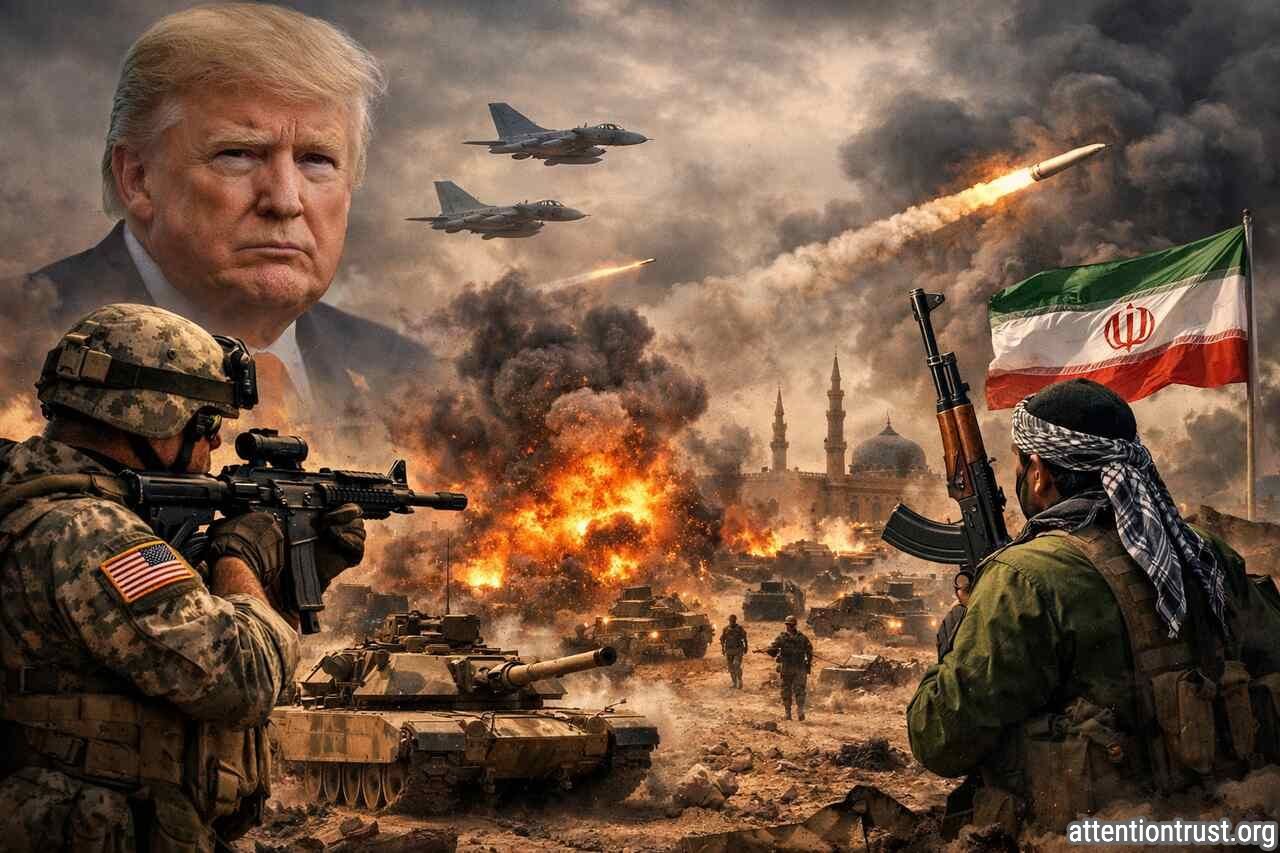
The potential for conflict between the US and Iran intensified as Donald Trump issued a warning to Tehran, emphasizing the dwindling timeline and the rapid approach of a formidable US armada that was on its way with determination and strength.
In a message shared on social media, the American leader announced that on Wednesday, he had dispatched a fleet led by the USS Abraham Lincoln, which surpassed the size of the previous one sent to Venezuela during the recent ousting of Nicolás Maduro. He also declared that this fleet was fully equipped and ready to swiftly execute its missions with force, if needed.
Trump urged for prompt negotiations with Iran to reach a mutually beneficial agreement, emphasizing the need to prevent nuclear weapons and stressing the urgency of the situation.
In his recent post, Trump made it clear that he is ready to launch a military attack soon if Iran does not agree to negotiate regarding its nuclear program. This post also showcases a significant change in the White House’s reasoning for deploying a naval fleet to the area, shifting away from condemning the protesters’ deaths and focusing more on the status of Tehran’s nuclear plans.
Rumors suggest that his decision to exercise restraint stemmed from a lack of military resources in the region. The Gulf States had advised caution, while Israel had suggested waiting for more preparation time to handle potential retaliations from Iran.
According to activists, the recent unrest resulted in a death toll of over 30,000. During a Senate session on Wednesday, the US secretary of state , Marco Rubio, stated that numerous lives were lost and declared that the Iranian government is currently at its weakest point since the 1979 revolution.
Despite this, he emphasized that US personnel in the region should still be cautious of potential threats from Iranian missiles and drones.
According to Rubio, approximately 30,000 members of the US military are facing a potential threat from thousands of Iranian one-way UAVs and short-range ballistic missiles. He stressed the importance of having an adequate number of personnel in the region to protect against this danger.
According to Trump, in addition to keeping the “preemptive defensive option” of attacking Iran if there were signs of an impending assault on US troops, they have acquired a large number of ballistic missiles.
Over the weekend, European diplomats had anticipated a crisis arising and noticed Israeli uneasiness about the potential size of Iranian retaliation.
Efforts have been made by the Gulf States and Turkey to facilitate discussions between Iran and the US, but Tehran has declared that it will not engage in talks while feeling pressure or being subject to conditions.
At the World Economic Forum in Davos, Trump’s special envoy Steve Witkoff expressed his belief that a deal with Iran is necessary. During an interview with CNBC, he emphasized the importance of addressing multiple aspects such as missiles, enrichment, non-state actor proxies, and their stockpile of nuclear material.
Recent developments have revealed Trump’s efforts to restrict both the remnants of Iran’s dilapidated nuclear program and its long-range missile capabilities, which are considered the backbone of its military influence. Additionally, Trump has proposed that Khamenei vacate his position on the global platform, a demand which Iran is likely to reject.
When Senator John Cornyn inquired about the possibility of a regime change in Iran, Rubio acknowledged the longevity of the current regime. He stated that any potential changes would require careful consideration and could not be answered simply. It is impossible to predict what would happen in Iran if the supreme leader and his regime were to collapse.
The sudden escalation of the threat may serve as a useful distraction for those who feel that President Trump is facing pressure from domestic politics due to the violence carried out by homeland security officers in Minnesota.
According to the Iranian mission at the UN in New York, the US’s previous involvement in Afghanistan and Iraq resulted in a loss of $7tn and over 7,000 American lives. Iran is open to engaging in respectful and mutually beneficial dialogue, but will also defend itself with unprecedented force if necessary.
Abbas Araghchi, the foreign minister of Iran, stated that negotiations could not take place under threats. However, he did express his willingness to engage in talks without any preconditions, a message that has been conveyed to Witkoff through several intermediaries.
On Wednesday night, X shared that our courageous Armed Forces stand ready to respond swiftly and forcefully to any attack on our beloved territory, skies, or waters. Their fingers remain poised on the trigger for immediate action.
Iran has consistently embraced the idea of reaching a just and balanced nuclear agreement, based on mutual advantages and without any outside pressure or aggression. Such an arrangement would secure Iran’s right to utilize nuclear technology for peaceful purposes while also ensuring that no nuclear weapons are obtained.
Over the past day, both Araghchi and Iranian President Masoud Pezeshkian have communicated with representatives from Saudi Arabia, Qatar, and Egypt.
The three Arab nations are actively seeking solutions to resume negotiations without imposing predetermined conditions on Iran. They played a key role in convincing Trump to refrain from launching an attack three weeks ago. However, Trump currently has more leeway in terms of military actions and appears to be prioritizing a nuclear agreement over retribution for Iran’s violent crackdown on protests.
During a recent meeting, Hakan Fidan, the Turkish foreign minister, advised the US to separate their broader requests regarding Iran’s missile program and backing of militia in the region from the nuclear issue. He expressed his belief that attempting to address all concerns at once may result in Iran not cooperating.
Trump has consistently urged Iran to terminate its domestic nuclear enrichment efforts, allow the UN nuclear inspectors to resume their work, and transfer its highly enriched uranium supply to another country, potentially Russia. While Iran has not budged on ending its domestic capacity for uranium enrichment, it has been open to imposing strict restrictions on its stockpile.
The majority of Gulf states have expressed reluctance to grant the US access to their airspace or bases for a potential attack on Iran, citing concerns over potential retaliation from Iran.
Iranian officials stated that they will direct their efforts towards the base and area where air operations against them originate. They clarified that their actions were not directed towards any country, as they do not view them as enemies. Furthermore, they declared their intention to raise their defence preparedness against the US military build-up to its utmost level. In the event that the US proposes negotiations without any predetermined conditions, Iran will be open to it.
